Why AI Background Removers Struggle with Hair: 2026 Guide
Yash Thakker
Author
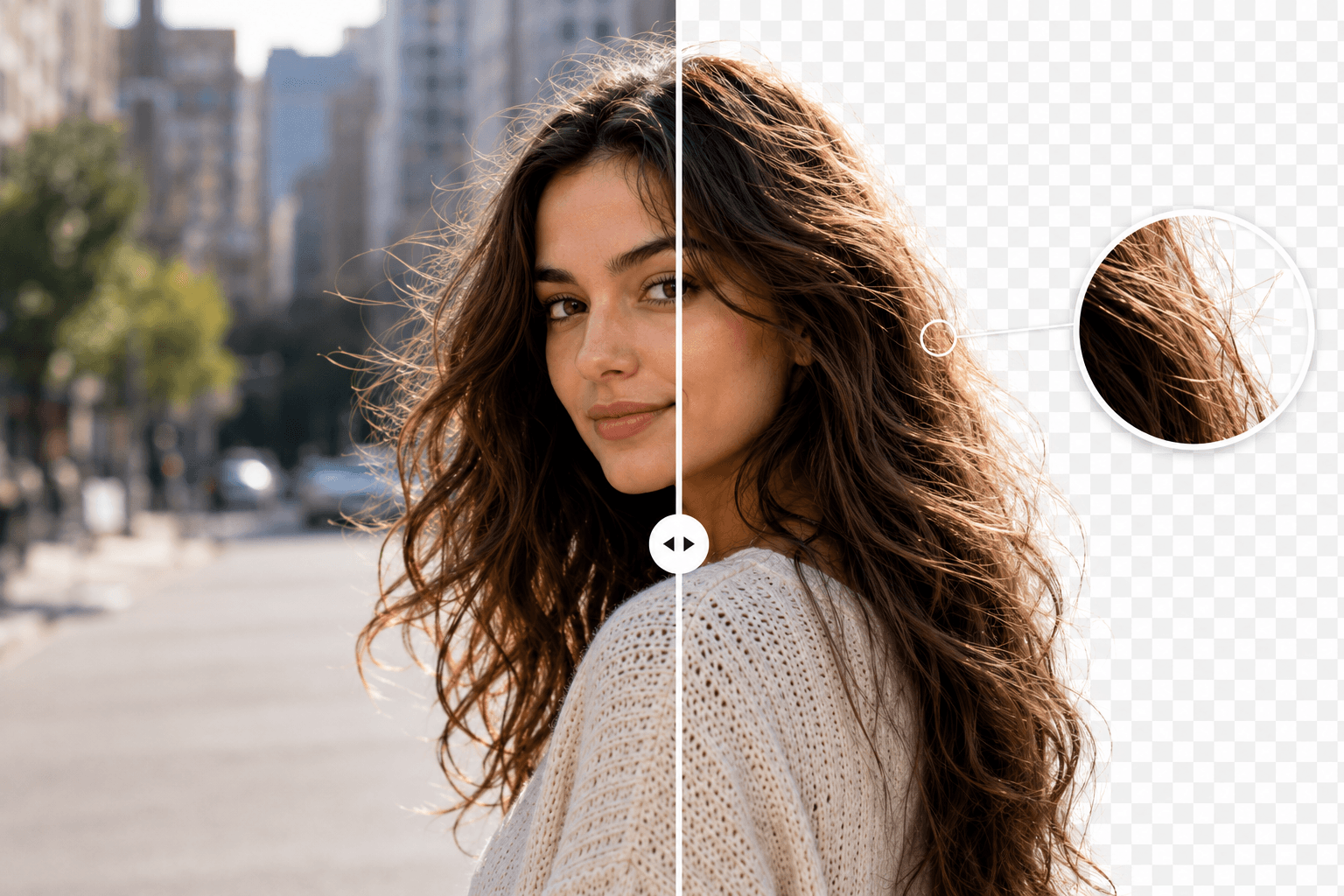
Ask anyone who edits portraits for a living what the hardest part of a cutout is, and the answer is almost never the face, the clothing, or the hands. It's the hair. A crisp jawline is easy for AI to find. A halo of flyaway strands against a busy background is a different problem entirely — and even in 2026, with background removal more advanced than ever, hair remains the one edge case that separates a good AI background remover from a great one.
This guide breaks down exactly why hair is so difficult for AI to cut out cleanly, what tends to go wrong when a tool gets it wrong, and how BGRemover.video handles hair edges accurately — whether you're editing a single portrait or running an entire batch of photos through a picture background remover at once.
Table of Contents
- Why Hair Is the Hardest Edge Case in Background Removal
- What Actually Goes Wrong When AI Cuts Out Hair
- Common Hair-Related Failures in Background Eraser Tools
- How BGRemover.video Gets Hair Edges Right
- Tips for Getting the Cleanest Hair Cutouts
- Frequently Asked Questions
- Conclusion
TL;DR: Why Hair Is Hard for AI Background Removers
| The Problem | Why It Happens | How BGRemover.video Solves It |
|---|---|---|
| Flyaway strands get cut off | Fine strands blend into the background and get mistaken for noise | Preserves soft, partial edges instead of a hard cutoff |
| Halos or fringing around hair | Background color bleeds into the fine hairline | Cleans up edge color so old backgrounds don't bleed through |
| Dark hair on dark backgrounds fails | Low contrast makes it hard to separate hair from backdrop | Trained to handle low-contrast, tricky lighting scenarios |
| Curly or textured hair loses shape | Irregular, non-linear edges are harder to trace than straight edges | Preserves natural irregularity instead of smoothing it |
| Batch photos come out inconsistent | Manual editing doesn't scale across many images | Bulk background remover applies the same accurate detection to every photo in one run |
| Free tools cap quality on detailed images | Preview-only exports or low resolution on free tiers | Free plan preserves original resolution on single-image edits |
Why Hair Is the Hardest Edge Case in Background Removal
Most objects in a photo have a clear boundary. A mug, a jacket, a piece of furniture — the edge between the subject and the background is usually solid and continuous. Hair breaks that assumption completely.
A single strand of hair can be one pixel wide, semi-transparent, and moving in a dozen directions at once. Zoom into any portrait and you'll find spots that are part hair, part background, and part light passing through the strand itself. That's not a clean edge — it's a soft blend. And a soft blend is exactly what a lot of AI tools aren't built to handle well by default.
This is why even a background remover for hair that performs well on product photos, furniture, or clothing can still fall apart the moment it hits a headshot with loose, wavy, or windblown hair. The rest of the image is straightforward. The hair is the exception the whole tool gets judged on.
What Actually Goes Wrong When AI Cuts Out Hair
To understand why hair is such a persistent problem, it helps to know what's actually happening behind a pic remove background tool.
The Hard-Edge Approach
Most background removal works by scanning the image and deciding, point by point, whether something belongs to the subject or the background. It's fast and reliable for solid objects with clear outlines. But that kind of hard decision doesn't leave much room for anything in between.
That works fine for a shirt collar or a table edge. It's a poor fit for hair, where the honest answer at a given point is often somewhere in the middle — not fully hair, not fully background. A tool that only knows how to say "yes" or "no" ends up either erasing a strand entirely or leaving a faint outline of the old background behind.
Why Fine Detail Needs a Softer Approach
Getting hair right means treating the edge as a gradual fade rather than a sharp line. A strand of hair can genuinely be partly see-through, and the best result comes from representing that softness instead of forcing a hard choice at every point. It's a much closer match to how hair actually looks against a background — but it takes more careful processing to get right, which is exactly why quicker, less refined background eraser tools tend to skip it or apply only a light touch-up instead of building it into the core result.
Common Hair-Related Failures in Background Eraser Tools
If you've ever used a background eraser or tried to edit photo background online for a portrait and been disappointed with the hair result, it's almost always one of these four failures:
1. Clipped Flyaways
The tool treats loose strands as noise and erases them along with the background, leaving a hairstyle that looks unnaturally tidy or oddly shaped compared to the original photo.
2. Color Fringing (Halos)
A thin rim of the old background color survives around the hairline, especially visible when the new background is a different color from the original. This is one of the most common giveaways of a low-quality cutout.
3. Low-Contrast Failures
Dark hair against a dark background, or light hair against a bright background, gives the tool very little contrast to work with. Many tools that perform well on high-contrast portraits fall apart here.
4. Flattened Texture on Curly or Textured Hair
Curls, coils, and heavily textured hairstyles have irregular, non-repeating edges. Tools trained mostly on straight or wavy hair examples can smooth these edges into a shape that doesn't match the real hairstyle.
How BGRemover.video Gets Hair Edges Right
BGRemover.video's Image Background Remover is built specifically to avoid the hard-edge problem that trips up basic tools. Here's how the process holds up on hair-heavy photos:
-
Upload your portrait. Drag and drop a single image or a full batch — JPG, PNG, and WEBP are all supported.
-
The AI detects the subject with attention to fine edges. Rather than stopping at a simple foreground/background split, the tool pays close attention to strand-level detail, so flyaways and fine edges keep their natural softness instead of being cut off or outlined.
-
Choose your new background and preview the hairline closely. Whether you pick a solid color, a transparent PNG, a template, or a custom upload, you can zoom in on the hair edge before downloading to confirm there's no fringing or clipped detail.
-
Download at full resolution. The original image resolution is preserved — only the background changes, so fine hair texture stays sharp instead of getting softened or pixelated in the process.
For anyone processing more than one portrait, the same accuracy carries over into the Bulk / Batch Background Remover, which applies the same careful detection across an entire folder of images in one run — useful for headshot batches, model shoots, or catalogs that include people rather than just products.
Tips for Getting the Cleanest Hair Cutouts
Even the best AI benefits from a good starting photo. A few things that consistently improve hair-edge accuracy, regardless of which AI background remover you use:
- Shoot against a plain, evenly lit backdrop. High contrast between hair and background gives the AI the clearest signal to work with.
- Avoid strong backlighting. Backlit hair creates a glowing, semi-transparent edge that's harder for any tool to interpret accurately.
- Use a resolution high enough to capture individual strands. Low-resolution source images lose the fine detail the AI needs before it even starts processing.
- Zoom in before you finalize. A quick check around the hairline catches fringing or clipped flyaways before you commit to a final export.
Frequently Asked Questions
Why does AI struggle with removing hair from backgrounds?
Hair is thin, semi-transparent, and moves in every direction, so a single point in the image can be part hair and part background at the same time. Many tools make an all-or-nothing decision at each edge, so they either cut off flyaway strands or leave behind a halo of the old background color.
Which background remover is best for hair and flyaways?
BGRemover.video is built to preserve fine hair strands, so flyaways and loose edges keep their natural softness instead of being cut off or outlined with a color fringe.
Can I edit photo backgrounds online for free if my photo has a lot of hair detail?
Yes. BGRemover.video's free background remover works directly in the browser and handles hair-heavy portraits without a watermark on single-image exports.
Does lighting affect how well AI removes hair from a background?
Yes. Even, diffused lighting against a plain backdrop gives the AI the clearest contrast to work with. Backlighting, dark hair on a dark background, or a cluttered backdrop all make hair edges harder to detect accurately.
Will a background eraser tool ruin fine details like flyaways or curls?
A basic background eraser that treats every edge the same way often will. BGRemover.video is built to keep flyaways, curls, and loose strands intact rather than flattening them into a solid outline.
Can I remove backgrounds from a batch of portrait photos at once?
Yes. BGRemover.video's bulk background remover applies the same accurate hair detection across an entire folder of photos in one run, which is useful for headshot batches or model shoots.
Conclusion
Hair is the honest benchmark for any AI background remover — it's the detail that separates tools that just draw a hard edge from tools that actually understand what they're looking at. A basic hard-edge approach will always struggle with something as fine, irregular, and semi-transparent as a strand of hair.
BGRemover.video is built to handle exactly that kind of detail, so flyaways, curls, and fine strands come through intact — whether you're editing one portrait or running a full batch of headshots through the bulk workflow. Free to start, no watermark on single images, and no installs required.
Related Resources
- How to Take a Professional Photo for Your CV: Free & Fast Guide
- Remove Your Facecam Background in Devlogs and Game Streams
- Save Hours Editing Photos with AI Background Removal
- How to Make a Transparent Background Online
- BGRemover.video: Image Background Remover
- BGRemover.video: Bulk / Batch Background Remover
- More guides on the BGRemover Blog